

When you’re building your new home, the floor plan gets all the attention. So do the countertops, the exterior elevation, and the cabinet finish. Those are the decisions that feel big because you can picture them.
 What new home builders often miss are the smaller functional details that don’t show up in a 3D rendering: A bathroom with no counter space near the vanity. A kitchen with one outlet behind the toaster and none near the island. A garage with no hose bib on the backyard side of your house.
None of these problems cost much to solve during a build. All of them become inconvenient or expensive to fix after closing day.
This list covers 24 small things that get forgotten when building a new home. We start with items any new home builder should think through, then we cover what a well-run design review process, like the one CMS Homes uses in our semi-custom build process, catches before the walls close.
Electrical Outlets and Light Switches
Most builders follow code minimums for outlet and switch placement. Code minimums are not designed around how you live. You will want to work through each room’s actual purpose before framing begins.
1. Kitchen outlet count and spacing: One outlet above the backsplash every four feet is the number most buyers wish they had planned for. Two outlets on a long counter section, both shared, creates a daily frustration.
2. Island outlets: A kitchen island without outlets gets used as counter space and nothing else. Confirm the outlet count and placement on the island before cabinetry is finalized.
3. USB charging station near entry: A dedicated spot near the garage entry or mudroom with USB outlets removes the phone-on-the-floor charging setup from every room in your house.
4. Bedroom outlets on both nightstand sides: One outlet on the wall behind the bed is not enough. Both sides of the bed need power, and USB ports on both sides are worth specifying in a new build.
5. Bathroom vanity outlet height and placement: Counter-height outlets serve better than wall-level ones when paired with a floating vanity. Confirm placement before tile work begins. Moving an outlet after the fact means cutting into finished surfaces.
6. Three-way switches at stairs and hallways: Three-way switches belong at both ends of every staircase and long hallways. Without a three-way switch, when you flip a light on from one end but have no way to turn it off from the other. The cost to input these switches early on is minimal.
7. Dimmer switches in main living areas: Dimmers in the great room, dining room, and primary bedroom cost very little at the rough-in stage and change how a space feels entirely at night.
8. Under-cabinet lighting before cabinets install: To add under-cabinet lighting after the cabinets go in, contractors cut into finished work. Specify it before installation and the wiring is clean and concealed.
Laundry Room Details
The laundry room is one of the most-used spaces in your house and one of the least considered during design. A few specifics to work through before framing:
9. Utility sink: For pre-treating clothes, rinsing garden tools, washing paint brushes, and a dozen other tasks. A laundry room without a utility sink becomes a room you work around as opposed to a room that works for you.
10. Folding surface: Counter space above the washer and dryer, not a shelf but an actual work surface, makes the difference between a functional room and a staging area for clean laundry that never gets folded.
11. Storage above the machines: Upper cabinets or open shelving keep detergents, stain removers, and supplies off the folding surface. Specify this at the design phase rather than retrofitting shelving after move-in.
12. Hang-dry rod: A rod for hang-dry garments is a low-cost addition most buyers don’t think of until move-in that can make a world of difference!
13. Sound insulation near bedrooms: A washer on spin cycle at 11 PM has a simple framing-phase solution: add insulation between the laundry room walls and the adjacent bedroom. You will want to catch this before the drywall goes up.
Closet and Storage Configuration
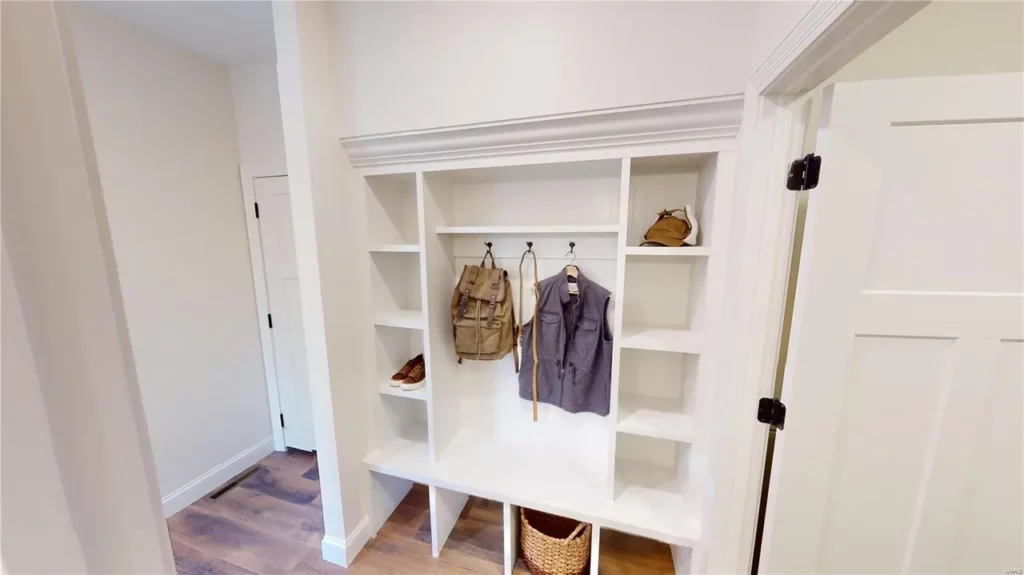
You will want to carefully specify the internal configuration of your (walk-in) closets. Work through how you store clothing before your builder finalizes the design.
14. Walk-in closet internal layout: Rod height, shelf depth, and double-hang sections all affect daily use. A closet with one long rod and two shelves stores far less than the same space with a planned configuration.
15. Linen closet depth: Standard linen closets run 16 inches deep. An increase to 20 or 24 inches changes what you can fit on each shelf, particularly relevant for large comforters and bulk storage.
16. Pantry shelf depth: The same logic applies to pantry shelves. If you stock large containers or countertop appliances, standard shelf depth makes the pantry less functional than it could be.
17. Pull-out drawers in base cabinets: Access to the back of a 36-inch base cabinet is a daily frustration with a simple build-phase solution. Pull-out drawers instead of fixed shelves are far easier and less expensive to add during construction.
Outdoor Details That Get Overlooked
The exterior aesthetics of a new home gets real attention during the planning phase. Outdoor functionality can suffer as a result. Here’s what you never want to overlook in your outdoor functionality.
18. Hose bibs on multiple sides of your house: Most builds include one outdoor water spigot. One is not enough. Plan for a hose bib at the front, the rear, and at the side facing your garage or yard. Do this before the concrete is poured.
19. Outdoor outlets and EV charging: Front porch, rear patio, and garage exterior outlets handle landscape lighting and outdoor tools without extension cords. If a hot tub or EV charger is a possibility for your family in the next five years, the electrical costs very little now and a great deal later.
20. Gutter drainage direction and termination: Where roof water exits and how far it travels from the foundation affects your lawn, your landscaping, and over time, your basement. Underground drainage to a pop-up emitter at the edge of the yard is the cleanest solution. Plan for it before the lot is graded.
21. Driveway and walkway width: Two cars need to pass each other. Guests need a front walk wide enough that they do not have to step onto the lawn. Confirm these dimensions before any concrete work begins.
Pre-Wiring and Rough-Ins
According to the National Association of Home Builders, storage capacity and electrical access are among the top features buyers wish they had planned more carefully in new construction. Both are problems with a design-phase solution, not a move-in solution.
Pre-wiring is the category where new home builders most often say they wish they had thought ahead. Once drywall is up, adding these elements means cutting into finished walls. The labor cost at rough-in is a fraction of what it costs after the fact.
22. Low-voltage wiring for data, audio, and security: Speaker systems, security cameras, and a whole-home data network all need to be wired before the drywall does. Wi-Fi handles some of this, but a hardwired data network outperforms wireless for reliability and speed, and it cannot be added cleanly after the walls close.
23. Conduit to a detached garage or lot edge: A conduit run to a detached garage or to the edge of your lot gives you options later: outdoor lighting, a future gate, an outbuilding, without tearing into finished surfaces.
24. Gas line rough-ins: Gas rough-ins for an outdoor grill, a fireplace, or a garage heater cost far less to cap at the right location during the build than to trench for later.
For a full picture of what gets locked in during construction, read: 8 Interior Features You Cannot Change Once Your Home Is Built.
How a Good Design Review Catches What You Miss
The details on this list do not require construction expertise to request. They require someone to ask about them before the walls close.
At CMS Homes, the design review with our in-house team is built to work through all of it. Our semi-custom floor plans give you a strong foundation, and we structure your selection process to refine around how you actually live, not just how the plan looks on paper. Sales consultations and estimates are free.

Contact CMS Homes to schedule your free estimate.
Ready to begin your journey toward homeownership with CMS Homes? Stop by one of CMS Homes’ three display homes located in Orchard Grove, Moscow Mills, Missouri and see how easy it is to get a realistic new home estimate and explore available lots. We’re here to help, Monday through Saturday, 11 AM to 5 PM, or by appointment.

0 Comments